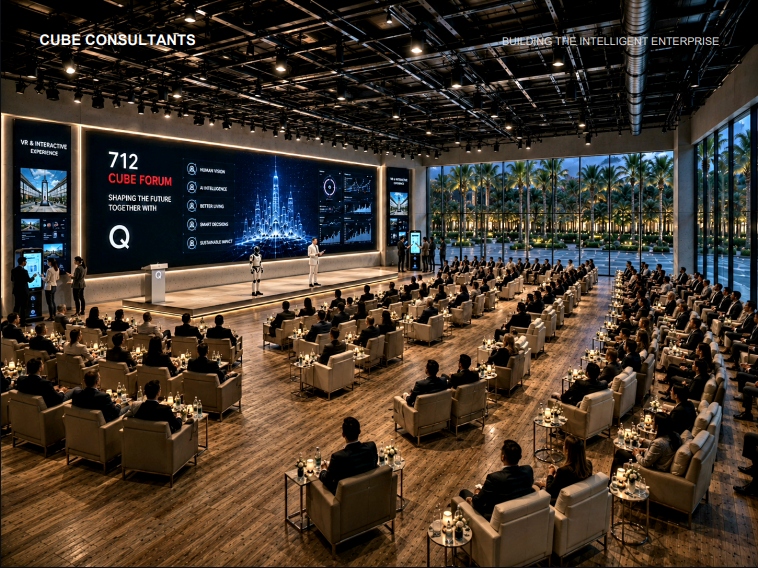
Egypt has never lacked ambition — it has lacked a framework capable of uniting that ambition. EGYPT 712, the Integrated Vision for Egypt, is exactly that framework: a comprehensive national blueprint prepared by the "Emar Misr" initiative of the non-profit Rimal Foundation, designed to bring together the ideas of experts and specialists across every discipline, alongside the aspirations of Egyptians from all walks of life, under a single accountable institutional structure monitored by civil society.
The Vision: Back to the Future
At its heart lies a simple but powerful proposition: Egypt's future lies in reclaiming its past leadership. The vision aspires to an Egypt that is simultaneously a human, scientific, industrial, technological, touristic, cultural, and green nation — a country ranked among the best seven nations in the world.
The number 712 itself carries the vision's DNA:
The human, spiritual, social, cultural, economic, political, and ecological dimensions of national life.
Science, Faith, and Land — applied across every field of development: people, place, time, and territory.
Measurable national targets set for key benchmark years: 2040 and 2060.
The Method: Science, Faith, Land
Rather than treating development as a collection of disconnected projects, EGYPT 712 organizes the nation's transformation through a set of Egypt 712 National Codes — integrated codes spanning ethics and human values, investment in human capital, science and education, healthcare, urbanism and quality of life, transport, renewable energy, culture and the arts, environmental balance, water resources, agriculture, industry, mining, economy and trade, heritage conservation, tourism, information technology, and governance.
Each code is paired with concrete mechanisms, projects, economic programs, and a time-bound implementation program within the 712 system, prioritized according to national need.
From Vision to Territory
What distinguishes EGYPT 712 as an urban vision is its insistence on translating national aspiration into physical form. The vision imagines specialized capital cities — Egypt's seven capitals — each anchored to a distinct national mission:
- Cairo — Capital of culture and tourism
- New Administrative Capital — Seat of government
- East Port Said — Trade and finance capital
- Alexandria — Capital of science and knowledge
- Luxor — World heritage capital
- Aswan — Capital of the Nile
- Sallum — Space sciences capital
Around them, the vision maps cities of reclaimed leadership: shipbuilding cities, furniture and textile manufacturing hubs, medical cities, marine sciences and diving tourism, therapeutic tourism, traditional crafts, and the Egyptian architecture city — together with golden-mining cities, solar and wind energy cities, and a space sciences city spanning one hundred thousand feddans.
Measurable Ambition
EGYPT 712 is not rhetoric; it is quantified. The vision sets explicit national indicators:
| Indicator | Today (Baseline) | 2040 Target | 2060 Target |
|---|---|---|---|
| Population | 83 million | 120 million | 200 million |
| Inhabited Land | 7% | 25% | 40% |
| GNP | $188.4 billion | $1,200 billion | $3,200 billion |
| Education Share of GNP | 5% | — | 25% |
| Healthcare Share of GNP | 10% | — | 15% |
Behind these numbers stands a confident reading of Egypt's real wealth: a strategic position at the center of the world's landmass, vast unexploited territories, the Nile, more than two-thirds of the world's monuments, over 2,000 km of beaches, 27 natural protectorates, the Suez Canal, mineral and hydrocarbon wealth, and one of the world's largest reserves of groundwater — all in one of the countries least exposed to natural disasters.
A Dream Rooted in Identity
The vision's founders describe its purpose plainly: restoring Egyptian identity, belonging, dignity, urbanity, intelligence, science, arts, and culture — producing a generation capable of creativity and invention, harnessing the constructive energies of Egyptian youth, and returning Egypt to its global standing, led by the human sciences.
"We need to review our steps and evaluate our performance; to plan our future with faithful hearts, conscious will, and enlightened minds, so that we correct our course and achieve for Egypt all that we aspire to."
EGYPT 712 stands as a testament to what thoughtful urban and national planning can offer: not merely a set of projects, but a coherent, humane, and measurable path back to the future.