Introduction
For years, the Architecture, Engineering, and Construction (AEC) industry has treated coordination as the ultimate milestone before issuing construction documents. Teams proudly announce: "The model is clash-free."
Yet, projects continue to experience design changes, RFIs, construction delays, and costly site modifications. The question is simple: If coordination was successful, why do problems still appear on site?
The answer is equally simple: Because coordination verifies compatibility — not correctness.
The Biggest Misconception in Design Delivery
Many organizations unconsciously follow a workflow where QA reviews happen at the very end. Unfortunately, this means teams spend weeks coordinating designs that were never technically validated in the first place.
- A model can be perfectly coordinated... and still violate building codes.
- It can still fail operational requirements.
- It can still create maintenance problems.
- It can still generate expensive variations during construction.
Coordination Answers Only One Question
Coordination is extremely valuable. But it answers only one question: "Can all disciplines physically coexist?"
It checks for physical clashes, spatial conflicts, model interference, and element alignment. These are important, but they represent only a fraction of design quality.
Validation Answers the Harder Questions
Validation asks questions that clash detection cannot answer:
- Does this comply with the building code?
- Is the fire strategy correct? Can occupants evacuate safely?
- Is maintenance actually possible?
- Are the spaces functional?
- Can the contractor build this efficiently?
- Does the design satisfy the client's operational requirements?
These questions determine whether the project succeeds — not whether two ducts intersect.
A Clash-Free Model Can Still Be a Failed Design
Imagine the following situations:
- Every exit width is below code requirements.
- Fire hose cabinets are correctly coordinated but exceed travel distance limits.
- Parking circulation works in BIM but cannot accommodate real vehicle turning paths.
- An AHU room has enough space but no future maintenance access.
- Structural beams do not clash with ducts, yet leave insufficient ceiling clearance.
No clashes. No warnings. No BIM errors. Yet every one of these examples represents a design failure.
The Right Sequence
Instead of treating validation as a final QA step, it should become the first quality gate. When validation happens first, coordination becomes significantly faster because each discipline enters the process with technically sound designs.
The Future Is Intelligent Validation
Artificial Intelligence is changing how technical reviews are performed. Instead of relying solely on manual checking, AI can validate hundreds of rules in minutes:
- Building code compliance
- Life safety requirements
- Accessibility standards
- Space standards & Constructability
- Company design standards
- Lessons learned from previous projects
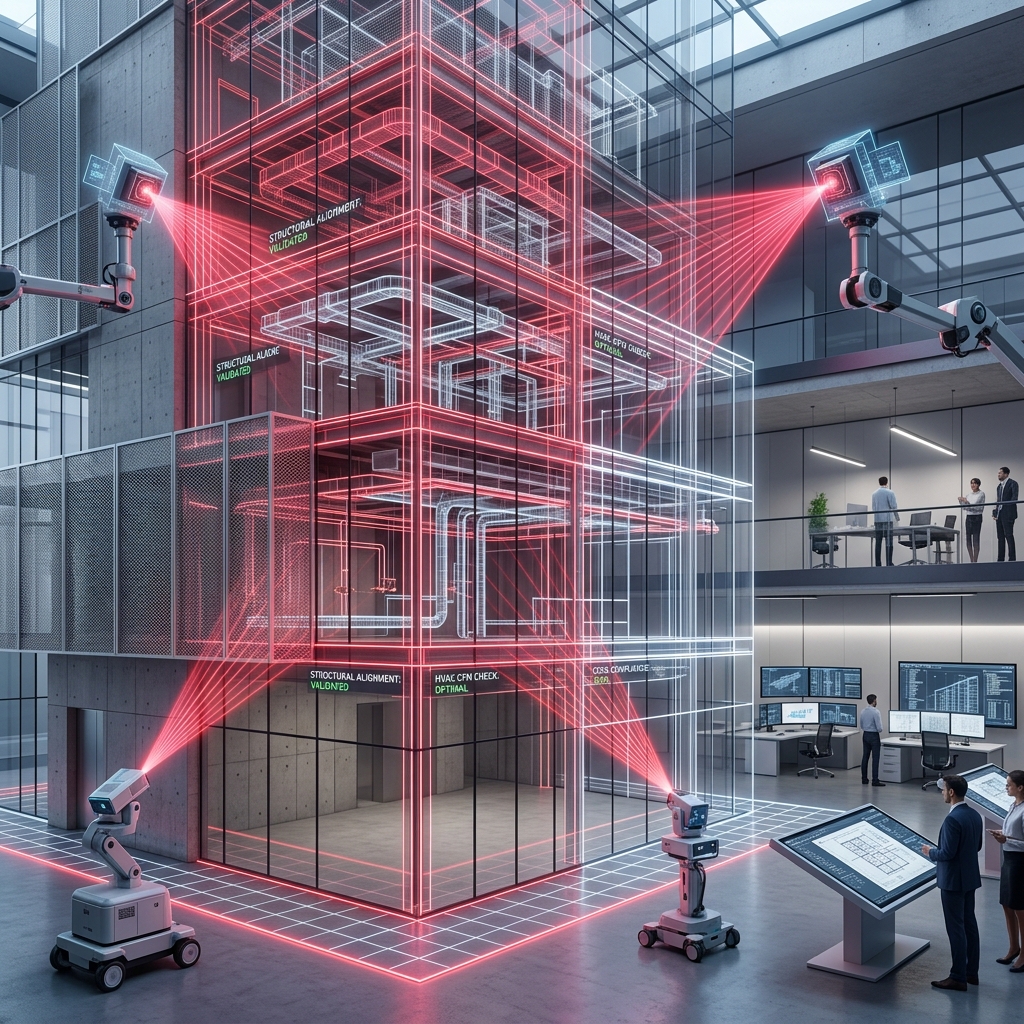
Coordination identifies where elements collide. AI-powered validation identifies where decisions fail. The future of design quality lies in combining both — not replacing one with the other.
Conclusion
The industry has spent years measuring success by the number of clashes resolved. Perhaps it is time to measure success differently.
Not by asking: "Is the model coordinated?"
But by asking: "Is the design correct?"
Because in the end... A coordinated design is not necessarily a correct design.
الملخص باللغة العربية (Arabic Summary)
النمذجة الخالية من التعارضات لا تعني بالضرورة أن التصميم صحيح. يعتقد الكثيرون أن حل التعارضات بين التخصصات المعمارية والإنشائية والكهروميكانيكية هو الخطوة النهائية قبل البناء، ولكن هذا إجراء للتحقق من التوافق وليس الصحة الفنية والتنظيمية.
إن عملية التدقيق والتحقق من كود البناء، ومتطلبات السلامة وإمكانية الصيانة هي التي تحدد نجاح المشروع الحقيقي قبل البدء في التنسيق بين الكتل والشبكات.